
Genetic Results for ABCD Study Participants

Beginning in Fall 2025, the ABCD Study identified new genetic information using DNA from blood or saliva samples you previously provided. This information examines your DNA for a specific list of genes identified by the American College of Medical Genetics (ACMG). These genes are known to increase risk of developing certain diseases or health conditions, like some cancers and types of heart disease. These conditions are substantially treatable or preventable when diagnosed early.

Participants age 18 or older can choose to receive their personal genetic results.

The initial test results from ABCD will let you know if you might have differences in some of these genes. If you do, we will offer you the opportunity to be connected with another company to do a clinical test to confirm that you have those gene differences at no cost to youYou can decide whether you want to be connected and whether you want these results or not.

Learn More About Genetic Risk Results

ConsentingTo help you decide, we have created materials that explain:

  • How DNA can affect your risk for certain diseases and health conditions;

  • What health conditions you will find out about and your probability of having one of these gene differences;

  • How we will check your genetic risk and share the results with you if you want them; and

  • The pros and cons of getting your results and the choices you have to get them.

You will be asked to review these materials before your visit.

There is no cost to you for your participation in any part of this process. Choosing to receive your genetic risk results is optional and will not impact  your participation in ABCD.

Frequently Asked Questions

We understand that you might have a lot of questions before you make your decision to learn about your genetic risk.
To help you navigate this process, provided below are some frequently asked questions and answers. If you have further questions, please contact your ABCD study site for more information.

Genetics and My Health

A gene is an individual unit of DNA that is passed on from generation to generation.

DNA is a biological molecule found in cells that contains instructions for how the body works.

DNA is an important part of what makes you, you. It carries information that is passed on from one generation to the next. For example, DNA determines things about you like the color of your eyes, and it’s why children often look like their parents. DNA can also influence our health and our risk of getting specific diseases and conditions.

Genetics can influence the risk of many diseases. However, we will only look at certain genes that are on a specific list, developed by the American College of Medical Genetics (ACMG). This list does not include conditions for which there is no medical treatment option.

Even after we do the initial analysis of your entire genome, it takes additional work to look for specific genes. We are only doing this additional evaluation for the genes from the ACMG list. 

A group of scientists, genetic counselors, bioethicists, and other experts from the American College of Medical Genetics have carefully designed this list as a minimal list of genes that are very likely to put you at high risk of getting a condition or disease that is also treatable or preventable. 

We want to provide results that can inform your health care decisions. For some genetic conditions that don’t have a medical treatment, you may have a family history of these disorders (like Muscular Dystrophy). You can find out about these sorts of conditions through targeted testing from a doctor.

The analysis we did on your DNA in the past did not provide enough information to detect these genes. We are now doing an analysis that looks at your entire genome, which allows us to identify these genes, and it is our ethical duty as scientists to offer you the opportunity to receive these results if you want them.


Genetic Return of Results Process

ABCD scientists will do an initial screen of your DNA through your blood or saliva to look for genetic risk factors.

 If you don’t have a genetic risk for a disease or condition based on the ACMG list screen: you will get a report that says so and explains what this means.

 If you do have a genetic risk for a disease or condition based on the ACMG list screen:

  • Someone from the ABCD Study team will contact you and connect you with a company that offers clinical genetic testing and genetic counseling.
  • You will create an account with the genetic testing company.
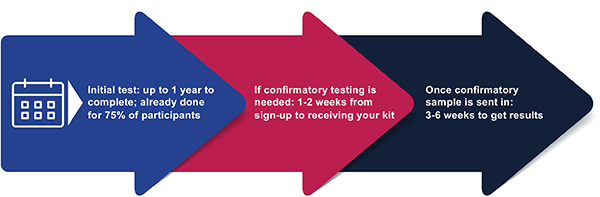
  • The company will send a kit for you to provide another saliva sample.
  • The company will repeat the test to confirm the results from the ABCD screen.

 If the repeat test is positive, a genetic counselor will:

  • Send you a report
  • Tell you what your results mean
  • Answer your questions
  • Send a report to your health care provider (if you want), who can help you decide what medical treatment or tests you might need.

 The repeat test will only be negative in very rare cases. If the repeat test is negative, you will receive a report that will tell you what your results mean.

A genetic counselor is a health care professional trained to help people understand how their genetics may affect their health, but they don’t provide treatment.

Watch a video to learn more about genetic counselors.

There are nearly 12,000 participants in the ABCD Study, and we still need to analyze the genetic data from a few thousand participants. This means it may take a year or more to get your results. If you agree to receive your results but you don’t hear from anyone in the ABCD Study, your sample may not have been tested yet.

Return of Results

These results are NOT a diagnosis and do NOT tell you whether you have or will get a health condition. Also, a negative result does NOT mean that you won’t get one of the health conditions in the future.

  • Many factors influence your risk for disease, including your DNA, family history, your habits, and your environment.
  • Your DNA may contribute to your risk for health conditions, but it is only one factor.
    • For example, you may still develop high cholesterol due to diet or lifestyle factors even if you don’t have a gene that elevates your risk for high cholesterol.

Only a health care provider can diagnose you and determine how to treat you.

New information may become available in the future that could impact the interpretation of your results. If you want, the genetic testing service may notify you of updates related to your genetic test.

The genetic counseling service that the ABCD Study connects you with, and any additional resources and information they provide to you through their portal, are offered at no cost. However, if additional medical tests or procedures are needed, or if you need to see a specialist, those costs are not covered.

In general, most private, and some government-sponsored, health insurance plans will cover at least a portion of the cost of genetic testing if it is deemed medically necessary. However, it’s important to check with your specific insurance provider to determine your exact coverage and any out-of-pocket costs you may incur. 

Your genetic counselor may be able to help you understand the likelihood that your test will be covered and the policies for pre-authorization and billing.

If you live outside of the United States, you could still receive your initial results; however, unless you live in a U.S. territory, we will not be able to provide you with genetic counseling. This wouldn’t change anything about the process if you do not have one of the genes that we are testing for, and if you didn’t want pre-consent genetic counseling to make your choice. However, if you had a positive result, we will not be able to order the confirmatory test. You could bring your initial results to a health care provider in your country of residence to follow up, but the ABCD Study will not be able to cover any associated costs.